

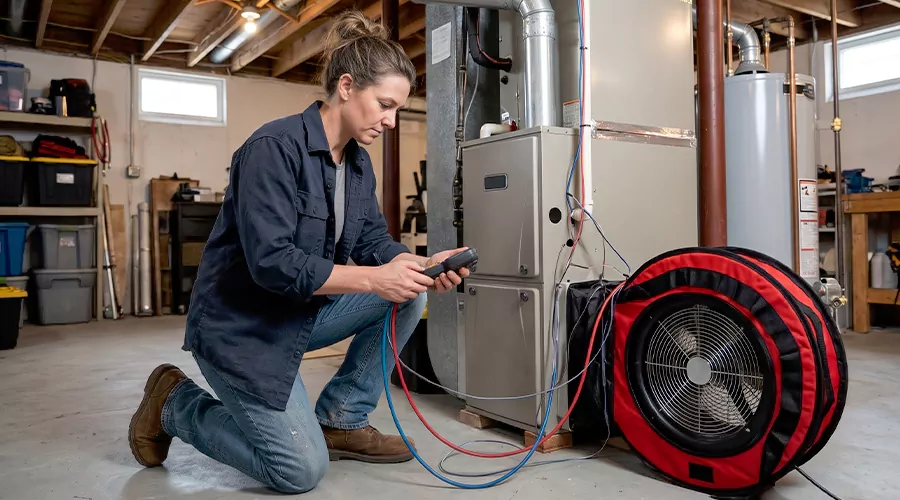
An HVAC duct leakage test measures how much air escapes through gaps, holes, and poorly sealed connections in a home's heating and cooling duct system. Professionals commonly perform the test using a calibrated duct-testing fan and a pressure-measuring device called a manometer. The results help determine whether duct sealing or repairs are needed. Professional HVAC duct cleaning can also remove accumulated dust and debris from ductwork when inspections show that cleaning is necessary.
Central HVAC systems move heated or cooled air through supply ducts and return indoor air to the furnace or air handler. When ducts leak, conditioned air may escape before reaching the intended rooms. Return-side leaks can also draw air from attics, crawlspaces, or other unintended locations into the system.
ENERGY STAR estimates that approximately 20% to 30% of air moving through typical residential duct systems is lost through leaks, holes, and poor connections. Duct leakage testing provides measurable information about a problem that may otherwise remain hidden behind walls and ceilings.
What Is the Purpose of a Duct Leakage Test?
The primary purpose is to measure the airtightness of an HVAC distribution system. Testing can help contractors determine whether the ductwork meets applicable energy-efficiency requirements or whether significant air leakage remains after installation. A test can also support decisions about sealing existing ducts.
Common reasons for testing include:
- High heating or cooling bills.
- Rooms that are difficult to condition.
- Suspected leaks in attic or crawlspace ducts.
- Newly installed ductwork.
- Major HVAC replacements or renovations.
- Required new-construction energy inspections.
- Verification after professional duct sealing.
Duct leakage testing is different from measuring how much air reaches each room. Both may be useful when evaluating HVAC performance.
How Does an HVAC Duct Leakage Test Work?
A duct leakage test uses a calibrated fan to create a controlled pressure difference within the duct system. Technicians temporarily cover supply and return registers, attach the testing equipment, and measure the airflow required to maintain the test pressure.
According to the U.S. Department of Energy's Building America Solution Center, residential duct leakage testing commonly uses a pressure of 25 pascals. If the ducts have openings, air escapes through them. The calibrated fan must supply additional air to maintain the target pressure. The amount of fan airflow needed provides the measured leakage rate.
What Equipment Is Used for Duct Leakage Testing?
| Equipment | Purpose |
|---|---|
| Duct testing fan | Pressurizes or depressurizes ductwork |
| Digital manometer | Measures pressure differences |
| Calibrated airflow measurement system | Determines leakage airflow |
| Temporary register covers | Seals supply and return openings |
| Flexible testing connector | Connects the fan to a duct opening |
| Pressure tubing | Connects measurement points |
| Blower door | Supports leakage-to-outside testing |
| Inspection tools | Help locate suspected defects |
Common commercial duct testing systems include the Minneapolis Duct Blaster and Retrotec duct testers.
Testing should be performed using an appropriate recognized procedure, such as ANSI/RESNET/ICC 380, by personnel familiar with the equipment.
How Is an HVAC Duct Leakage Test Performed?
Step 1. Inspect the Duct System
The technician identifies the supply and return registers, HVAC equipment, and accessible duct connections. The system configuration determines how the test will be performed.
Step 2. Prepare the HVAC Equipment
The contractor shuts down normal equipment operation and prepares filters and dampers according to the testing procedure. Any connected ventilation components must be handled appropriately for the selected test.
Step 3. Seal the Registers
Supply and return openings are temporarily covered using suitable removable materials. This allows the testing fan to measure leakage through unintended openings rather than normal register airflow.
Step 4. Connect the Testing Fan
A calibrated duct-testing fan is connected to an appropriate register or other approved access point. Pressure tubing and the manometer are installed according to the testing standard.
Step 5. Apply the Test Pressure
The fan pressurizes or depressurizes the ductwork to the specified pressure, commonly 25 pascals. The contractor allows the reading to stabilize.
Step 6. Record the Leakage Measurement
The tester measures the airflow required to maintain the target pressure. This reading is commonly expressed in cubic feet per minute at 25 pascals, abbreviated CFM25.
Step 7. Locate Significant Leakage
If results indicate substantial leakage, the contractor may inspect connections, register boots, equipment cabinets, and accessible duct sections. Suitable diagnostic tools can help identify where air is escaping.
Step 8. Complete Repairs and Retest
After appropriate repairs, the system can be tested again. Comparing before-and-after results shows how much measured leakage was reduced. The technician should remove all temporary register covers and restore the HVAC system to normal operating condition afterward.
What Is the Difference Between Total Duct Leakage and Leakage to Outside?
Duct leakage testing can measure different types of air loss.
| Test Type | What It Measures | Common Application |
|---|---|---|
| Total duct leakage | Leakage throughout the connected duct system | Overall duct airtightness |
| Duct leakage to outside | Leakage beyond the conditioned building enclosure | Energy-related leakage to attics, crawlspaces, and outdoors |
| Diagnostic leakage testing | Helps locate specific leaks | Planning repairs |
Total duct leakage includes openings in supply ducts, return ducts, and applicable equipment cabinets, whether located inside or outside the conditioned space.
Leakage-to-outside testing focuses on air escaping beyond the home's conditioned enclosure. The latter commonly requires a blower door to establish matching pressure conditions between the house and ducts.
What Does CFM25 Mean?
CFM25 means cubic feet of air per minute measured at a 25-pascal pressure difference.
It describes leakage under standardized test conditions rather than the amount of air normally lost while the HVAC system operates. Professional commercial HVAC duct cleaning can help remove accumulated dust and debris from commercial ventilation systems when inspection shows that cleaning is needed.
A higher CFM25 reading indicates more measured leakage for the tested system, but the number requires context. Technicians may normalize the result using the home's conditioned floor area to compare it with a particular energy-code or program requirement. The applicable passing limit depends on the code edition, testing stage, duct location, and program specifications.
What Is an Acceptable Duct Leakage Test Result?
There is no single passing value that applies to every residential HVAC system in the United States. The Department of Energy's Building America guidance describes different requirements used by energy codes and programs such as ENERGY STAR.
A new-construction project may have a specific maximum leakage rate based on conditioned floor area. Existing homes may be tested primarily to identify opportunities for improvement rather than to satisfy a new-construction requirement. Ask the contractor to identify the applicable standard and explain how the measured result compares with that requirement.
Is a Duct Leakage Test the Same as a Blower Door Test?
No. A duct leakage test evaluates the air distribution system, while a blower door test measures leakage through the home's building enclosure. A blower door typically fits within an exterior doorway and creates a controlled pressure difference between indoors and outdoors.
For a duct leakage-to-outside test, both devices may be operated together to distinguish leakage beyond the conditioned space. The tests evaluate different parts of building performance.
Can Duct Leakage Testing Find Every Leak?
A duct leakage test measures the amount of leakage but does not automatically identify every individual opening. Additional inspection may be necessary to locate leaking seams, damaged flexible duct connections, and poorly sealed register boots. Technicians may use visual inspection, controlled diagnostic smoke, or other suitable methods when appropriate.
Some concealed leakage locations can be difficult to access without opening finished construction. The test helps establish whether repairs are needed and provides a way to verify improvement afterward.
What Happens if Your Ducts Fail the Leakage Test?
A result exceeding the applicable limit indicates that additional sealing or repairs may be necessary. ENERGY STAR recommends using suitable HVAC mastic or appropriate metal tape to seal accessible leaks. Disconnected ducts require mechanical repair before sealing. Damaged or severely crushed sections may need replacement.
A contractor should inspect the duct network and prioritize significant problems, particularly in unconditioned spaces. After repairs, repeat testing can verify whether the leakage rate has improved sufficiently.
How Often Should HVAC Duct Leakage Testing Be Done?
There is no universal requirement to repeat residential duct leakage testing annually. Testing is commonly performed during new construction, major HVAC installation work, and energy-efficiency upgrades. Existing homes may benefit from testing when persistent comfort problems, unusually high bills, or suspected duct damage appear.
Retesting is also useful after sealing work because it documents the improvement. The appropriate frequency depends on the system's condition and project requirements.
Is Professional Duct Leakage Testing Worth It?
Testing can be useful when homeowners need reliable information about hidden air loss. Without measurements, it may be difficult to determine whether ducts are significantly leaky or whether sealing work was effective. The value is particularly clear when ducts are located in attics, crawlspaces, or other unconditioned areas.
However, leakage testing does not replace airflow balancing, equipment inspection, or room-by-room load evaluation. A qualified contractor should recommend the tests that address the actual problem.
Conclusion
An HVAC duct leakage test measures how much air escapes through the duct distribution system under controlled pressure. Technicians commonly use a calibrated duct-testing fan and manometer to record leakage at 25 pascals. Total leakage and leakage-to-outside tests provide different information, while before-and-after testing can verify duct sealing results. Homeowners experiencing uneven temperatures, high energy bills, or suspected duct damage may benefit from professional testing and appropriate repairs.